Insights
Learn how an AI logistics assistant enables logistics sales teams to automate workflows, use real-time data, and close more deals with AI-powered sales insights and automation tools.
Author:
Brian Li
Published on:
Logistics companies don’t have a data problem. They have an execution problem.
You already have:
Shipment data
CRM data
Market intelligence
Customer history
But your team is still:
Manually building lists
Working out of spreadsheets
Reacting to disruptions
Guessing who to target
That’s the gap.
And it’s exactly why the ai logistics assistant category is emerging.
Not another dashboard.Not another data provider.A system that helps your team execute in real-time.
An AI logistics assistant is an AI-powered system that helps logistics teams:
Identify the right shippers
Prioritize opportunities
Automate routine tasks
Improve decision-making
It combines:
Real-time data
Machine learning
Natural language processing
AI agents that take action
Instead of digging through dashboards, your team can simply ask:
“Which accounts should I go after today?”
“Who is experiencing supply chain disruptions?”
“Where are we losing deals?”
And get answers instantly—with actions attached.
According to McKinsey & Company, AI can improve supply chain forecasting accuracy by up to 50% and reduce lost sales by up to 65%—highlighting the impact of AI-driven decision-making in logistics. (McKinsey)
That’s the shift: From tools → execution.
A U.S. Department of Transportation study found that inefficiencies and bottlenecks in freight systems cost billions annually—reinforcing the need to streamline logistics operations and improve coordination across systems (read more on transportation.gov).
Most logistics companies are still running revenue on:
Spreadsheets
Static templates
Disconnected systems and tools
Manual workflows
Even at the enterprise level.
Your sales team is juggling:
CRM
TMS
ERP
Data providers
Outreach tools
But none of it is unified. So what happens?
Workflows break
Response times lag
Opportunities get missed
Decision-making slows down
Cross-functional silos
Meanwhile, your logistics operations run in real-time—tracking ETA changes, routing shifts, shipment updates, and supply chain disruptions.
But your revenue motion doesn’t. That mismatch is where deals are lost.
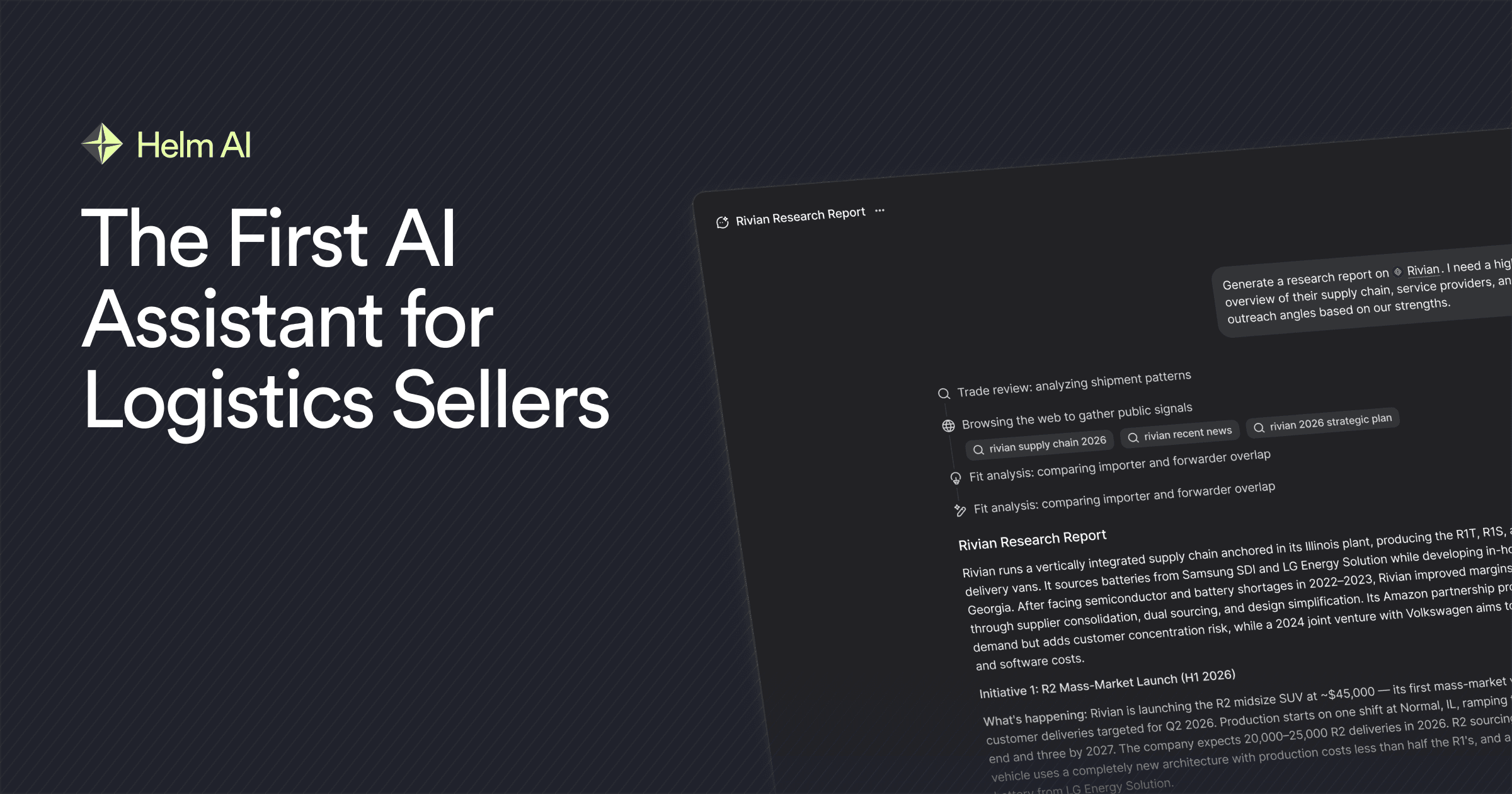
Helm AI is Revenue Vessel’s answer to this problem.
It’s the first AI logistics assistant designed specifically for:
3PLs
Freight forwarders
Logistics companies
Customs brokers
Drayage teams
Enterprise commercial teams
Helm doesn’t just analyze your data. It:
Tells you what to do
Helps you do it
And continuously improves how your team operates
Think of it as: The system that drives direction for your entire revenue engine.
Want to see how an AI logistics assistant works in practice?→https://www.revenuevessel.com/AI/helm
Most AI tools in the logistics industry act like a chatbot.
Helm acts like your best operator.
1. It Uses Real-Time Supply Chain Signals
Instead of static data, Helm pulls from:
Shipment updates
Routing changes
ETA shifts
Import/export activity
This gives your team:
Better timing
Better targeting
Better conversations
Example:
A shipper experiences delays → Helm detects disruption → Your rep reaches out with a relevant message.
That’s how pipeline gets created.
2. It Turns Data Into Action (Not Dashboards)
Most tools stop at insights.
Helm drives execution through AI-driven workflows. It:
Prioritizes accounts
Suggests outreach
Generates messaging using natural language
Tracks milestones automatically
No more:
Digging through dashboards
Guessing next steps
Just: Clear actions, every day.
3. One System for Everything Commercial
Helm AI consolidates your commercial tech stack across:
LinkedIn Sales Nav
Other import data providers
Contact providers
Sales outreach platforms
CRM
Everything becomes one unified AI platform.
That means:
No tool hopping
No tab overload
No confusion across providers
No disparate tools
No bureaucratic budget discussions
Just one system that streamlines everything.
Want to learn more about Revenue Vessel vs. others? Discover more here.
4. It’s Built for Sellers, Not Analysts
Most logistics software is built for operations. Helm is built for revenue.
That means:
No complex dashboards
No need for analysis
No reliance on spreadsheets
Instead:
Simple answers
Fast execution
Real impact
CROs: Build Predictable Revenue
CROs use Helm to:
Optimize pipeline generation
Improve forecasting with real-time data
Identify bottlenecks in the funnel
Sales Leaders: Scale Winning Workflows
Sales leaders use Helm to:
Standardize workflows
Reduce ramp time
Improve performance
Sales Reps: Focus on Selling
Sales reps use Helm to:
Identify high-intent shippers
Generate outreach using AI
Track shipment updates and milestones
Less admin. More selling.
Learn more: Mastering Logistics Sales: Strategies for Success
Sales Ops: Fix the System
Sales ops teams use Helm to:
Eliminate data silos
Automate reporting and summaries
Improve decision-making
Marketing: Target the Right Accounts
Marketing teams use Helm to:
Align campaigns with real-time supply chain signals
Improve demand forecasting
Increase conversion rates
Use Case 1: Prospecting High-Intent Shippers
Detect new activity
Prioritize accounts
Focus reps on real opportunities
Use Case 2: Acting on Supply Chain Disruptions
Monitor routing changes
Track ETA delays
Identify bottlenecks
Then act at the right moment.
Use Case 3: Optimizing Pricing Conversations
Analyze market shifts
Improve positioning
Increase win rates
Use Case 4: Streamlining Customer Support
Faster shipment updates
Better response times
Higher customer satisfaction
Use Case 5: Demand Forecasting
Use predictive analytics
Analyze trends
Help logistics managers plan ahead
This is exactly where an AI logistics assistant like Helm creates leverage for modern logistics teams.
You can explore how it works in more detail in thisAI logistics assistant platform overview.
Most tools give you:
Data without direction
Contacts without context
Reports without action
Even newer AI systems:
Act like chatbots
Require manual input
Don’t integrate deeply
They don’t solve execution.
According to Gartner, organizations that adopt AI in supply chain management can reduce operational costs by up to 15% while improving service levels—making AI a clear competitive advantage in the logistics industry.
Old Way
Fragmented tools
Manual workflows
Reactive operations
New Way
Unified AI systems
Automated workflows
Real-time execution
AI-driven decision-making
This is how logistics companies:
Reduce logistics costs
Improve customer satisfaction
Grow faster
What is an AI logistics assistant?
An AI logistics assistant helps logistics teams automate workflows, analyze real-time data, and improve decision-making across sales and operations.
How is it different from a chatbot?
A chatbot answers questions.
An AI assistant takes action.
Can it integrate with my systems?
Yes. It connects with CRM, TMS, ERP, and more.
Does it replace my team?
No. It removes routine tasks so your team can focus on high-value work.
The logistics industry is shifting.
The companies that win will:
Move faster
Use real-time data
Execute with AI
Explore the Helm AI logistics assistant and see how it can help your team streamline workflows, reduce bottlenecks, and close more business.